
What is a Project Ecologist? And When Do You Need One?
- Guy Smith
- Nov 30, 2025
- 4 min read

Getting your Development Application (DA) approved is a massive milestone. But for many developers and land managers in NSW, holding that approval is not the end of the ecological work—it is often just the beginning.
If you read through your Conditions of Consent, you will likely find a requirement to engage a "Project Ecologist" before a single tree is removed or a shovel hits the ground .
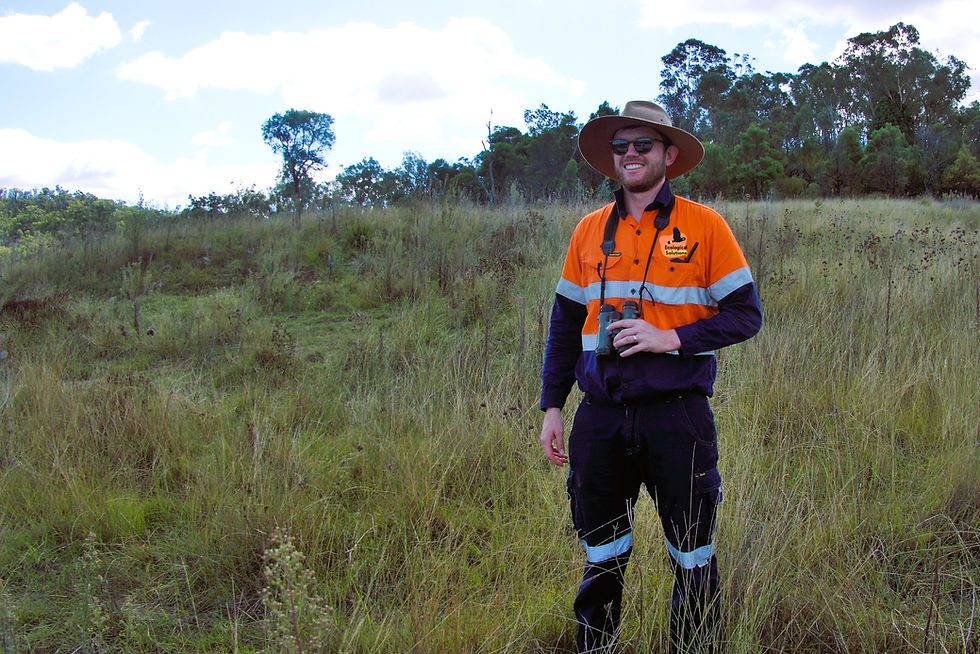
But what exactly is a Project Ecologist? Unlike the consultant who helped you get the DA approved, the Project Ecologist is focused on compliance, supervision, and operational management during the construction phase. Their role is to ensure that the "on-paper" promises made to the Council become "on-ground" reality.
Here is your guide to the role of a Project Ecologist and the critical post-approval requirements they manage.
When Do You Need a Project Ecologist?
You generally need a Project Ecologist once your DA has been approved but before you apply for a Subdivision Works Certificate or commence construction .
Councils in NSW, such as The Hills Shire Council, often include specific conditions requiring the appointment of a suitably qualified ecologist (usually with a university degree and industry experience) to supervise works . This ensures that biodiversity is protected during the most destructive phase of development: clearing and earthworks.
Failure to engage a Project Ecologist can lead to a breach of your development consent, stop-work orders, and significant fines.
The Core Responsibilities of a Project Ecologist
The role of the Project Ecologist is multifaceted, covering everything from pre-construction checks to long-term monitoring. Below are the key compliance stages we handle at Ecological Solutions.
1. Pre-Clearing Surveys and Exclusion Fencing
Before any machinery enters the site, a Project Ecologist must conduct a pre-clearing survey. This involves walking the site to identify and mark features that must be protected versus those approved for removal.
Exclusion Zones: We identify threatened flora species or sensitive ecological communities that must be retained. For example, in a recent project at Glenorie, we identified clusters of the threatened Pimelea curviflora and demarcated them with high-visibility bunting to create strict exclusion zones where no machinery could enter .
Habitat Marking: Trees approved for removal that contain hollows or potential habitats are spray-painted (often with a highly visible 'H') to alert clearing contractors that these trees require special handling .
2. Clearing Supervision and "Soft-Felling"
One of the most critical roles of the Project Ecologist is being on-site during the actual removal of trees . We don't just watch; we direct the method of removal to save wildlife.
We enforce a technique called "soft-felling." instead of felling a tree directly to the ground, an excavator equipped with a grab and saw attachment dismantles the tree in sections .
The operator gently lowers hollow-bearing limbs to the ground .
This prevents the catastrophic collapse of the tree, giving fauna inside a chance to survive.
3. Hollow Tree Inspections and Fauna Rescue
Once a habitat tree is on the ground, the Project Ecologist immediately inspects the hollows for wildlife. It is common to find gliders, possums, microbats, or reptiles hiding inside.
Fauna Relocation: If an animal is found, such as the Antechinus or skinks found during our recent supervision works, they are captured and relocated into nearby retained bushland .
Nest Inspections: We check nests to ensure they are empty. If eggs or juveniles are found, works may need to pause, or the fauna may need to be taken to a wildlife carer .
4. Nest Box Installation and Hollow Replacement
When hollow-bearing trees are removed, the habitat they provided must be replaced. This is often a condition of consent known as "compensatory habitat."
Typically, Councils require a replacement ratio. For example, for every one hollow removed, two nest boxes may need to be installed . The Project Ecologist is responsible for:
Selection: Choosing nest boxes designed for specific target species (e.g., microbat boxes vs. glider boxes) .
Installation: Overseeing the installation of these boxes in retained vegetation areas .
Mapping: Creating a map of installed boxes to prove compliance to the Council .
5. Vegetation Management Plans (VMPs)
Post-approval often involves long-term commitment to the land. A Vegetation Management Plan (VMP) is a document that outlines how retained bushland will be managed, rehabilitated, and protected in perpetuity .
The Project Ecologist or a qualified Bush Regenerator ensures the VMP is implemented by:
Managing weed and pathogen control .
Using local provenance planting stock (plants grown from seeds collected in the local area) for rehabilitation .
Ensuring buffer distances for effluent disposal or asset protection zones are maintained .
6. Ongoing Monitoring and Certification
Compliance isn't a "set and forget" task. Councils often require evidence of compliance at various stages.
Compliance Certification: After clearing, the Project Ecologist submits a formal letter or report to the Council/Certifier confirming that all supervision works, hollow salvage, and fauna protection measures were carried out strictly in accordance with the BDAR and consent conditions .
Long-term Monitoring: Some consents require monitoring reports for up to 5 years to ensure nest boxes are being used and replanted vegetation is surviving .
Why Compliance Matters
Ignoring these conditions does not just risk fines; it risks your Subdivision Certificate. A Subdivision Certificate (which allows you to legally create the new lots) cannot be issued until the Council is satisfied that all ecological works, including the VMP establishment, have been completed .
Engaging a Project Ecologist early ensures you have a clear paper trail of compliance—from the first pre-clearing survey to the final sign-off.
Next Steps
Do you have a Development Application approval that requires a Project Ecologist? Don't risk delays in your construction schedule.
Contact Ecological Solutions today. We can review your Conditions of Consent and provide a streamlined strategy for pre-clearing surveys, clearing supervision, and vegetation management planning to get your project certified and completed.
Comments